



Adeline & Linden St. Rail Corridors (Santa Fe & Key System)
You don’t have to look very hard to see how railroads shaped this part of Emeryville and North Oakland. Their imprint remains in the street grid, the scale of former industrial buildings now reused as loft housing, and in small open spaces that trace unusual, linear footprints. What appears today as fragmented urban fabric was once one of the East Bay’s most important rail corridors.
From the early 20th century until the late 1970s, Adeline Street and the parallel Linden Street corridor carried two distinct but interconnected rail systems. Adeline Street formed part of the Atchison, Topeka and Santa Fe (AKA AT&SF or shorthand “Santa Fe”) Railway’s transcontinental route, handling both passenger and freight traffic. Just one block east, Linden Street served as a main artery for the Key System, the electric interurban network connecting Emeryville and Oakland to Berkeley and beyond.
This concentration of rail infrastructure was rooted in rivalry. By the late 19th century, Southern Pacific tightly controlled rail access to San Francisco through its tracks strategically positioned along the shoreline and its ferry system. This created a near-monopoly and local merchants and civic leaders pushed back by backing competing rail ventures that promised lower rates and independent access to their markets.
Among these efforts was the California–Nevada Railroad (CNRR), an ambitious but ultimately unsuccessful attempt to build a competing route east from the Bay Area. Joseph Emery stepped in to help finance the project, tying the town’s early fortunes to railroad competition. While the CNRR failed financially, its right-of-way endured—and proved decisive.
Santa Fe completed its Richmond terminus in 1900, finally gaining a Bay Area foothold independent of Southern Pacific. Still, the company wanted access farther south and closer to ferry connections serving San Francisco. The collapse of the CNRR created that opportunity. In 1902, Santa Fe acquired the former CNRR alignment at public auction and rebuilt it to standard gauge.
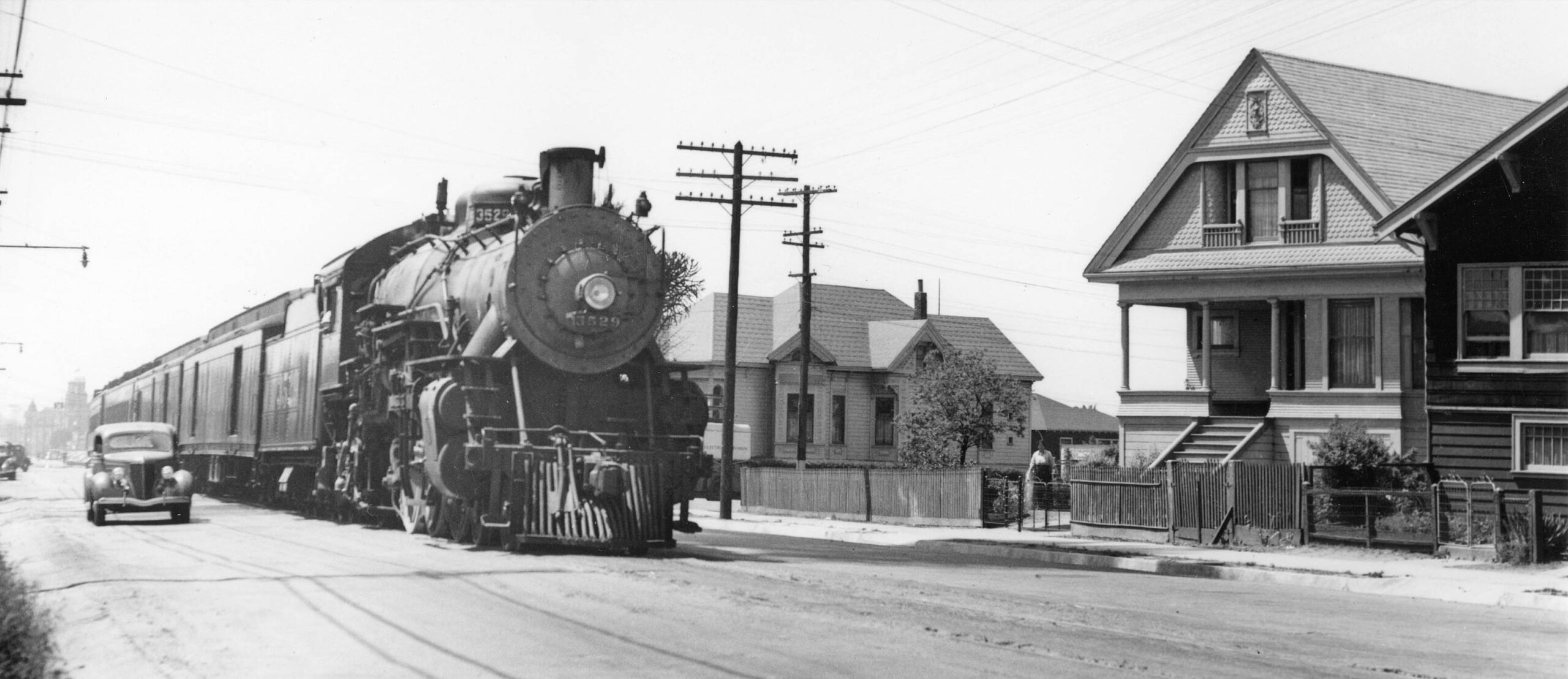
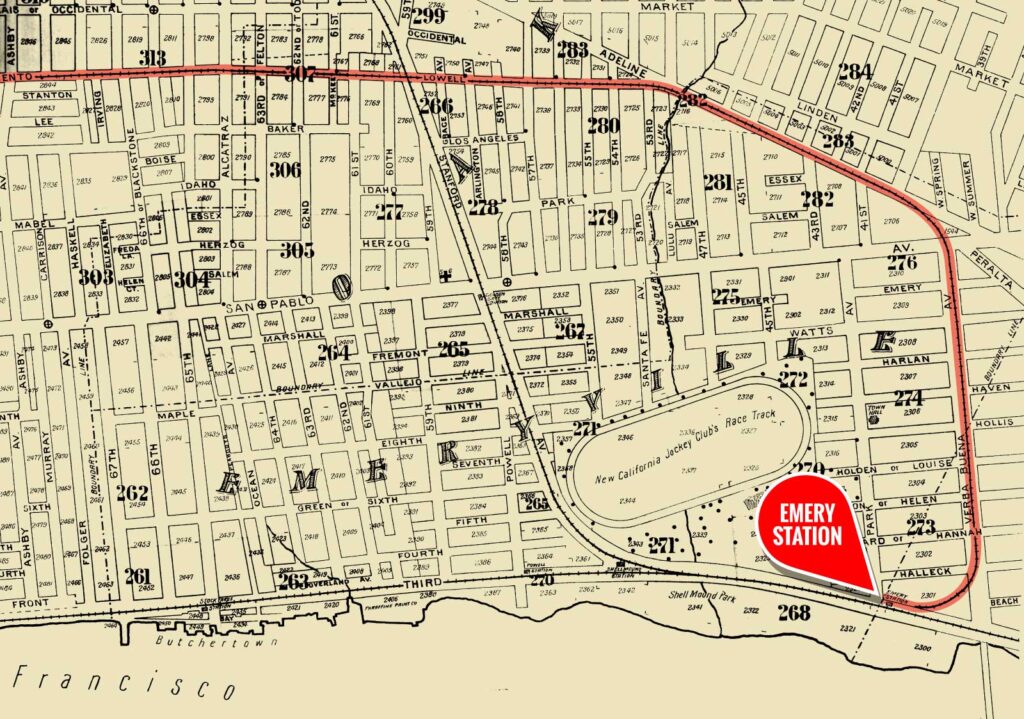
Two years later, in 1904, the first Santa Fe transcontinental train arrived in Emeryville, completing what became known as the “Oakland Extension.” The route ran south from Richmond through El Cerrito, Berkeley, and North Oakland, deliberately avoiding Southern Pacific’s shoreline tracks. Through Southwest Berkeley, trains followed Sacramento Street, turned onto Lowell Street, and then ran directly down the center of Adeline Street to a new depot near San Pablo Avenue and Yerba Buena.
For decades, Adeline Street carried trains that linked the East Bay directly to the national rail network. The line connected workers to factories, warehouses, and waterfront industries, while also feeding ferry terminals bound for San Francisco. After 1939, it tied directly into transbay rail service, reinforcing Emeryville’s role as a transportation hub.
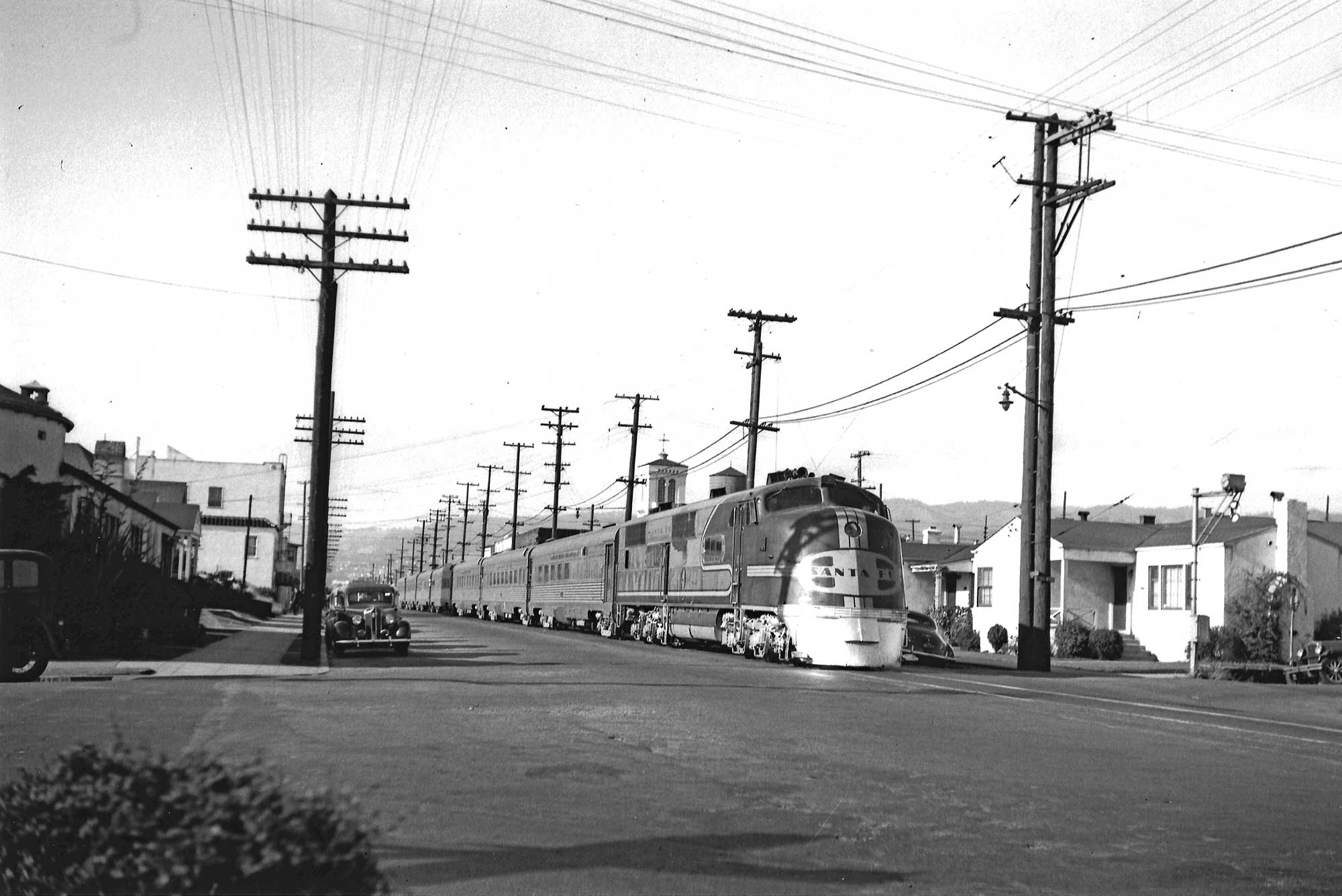
In 1938, Santa Fe introduced the Golden Gate Streamliner, offering sleek passenger service between the Bay Area and Los Angeles via the Central Valley. It marked the high point of intercity rail travel here. Passenger service ended by the mid-1960s, reflecting nationwide shifts toward automobiles, freeways, and commercial aviation. Freight service continued longer, serving industries along Adeline Street until 1979, when operations were rerouted and the tracks removed.
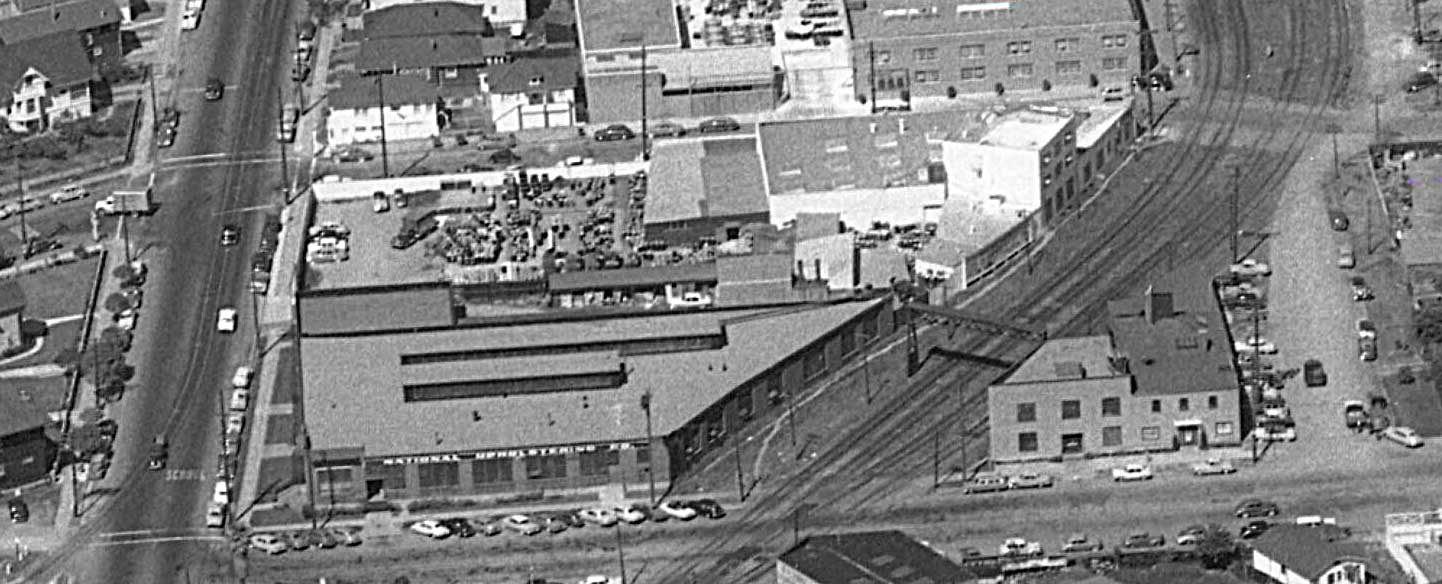
Running parallel to Santa Fe’s heavy rail line was the Key System, whose electric trains once carried thousands of daily riders. The Linden Street Corridor handled the E, F, and H lines, funneling cars through a grade-separated trench known as “The Cut.” This infrastructure allowed trains to bypass street traffic and move efficiently into Berkeley and downtown Oakland.
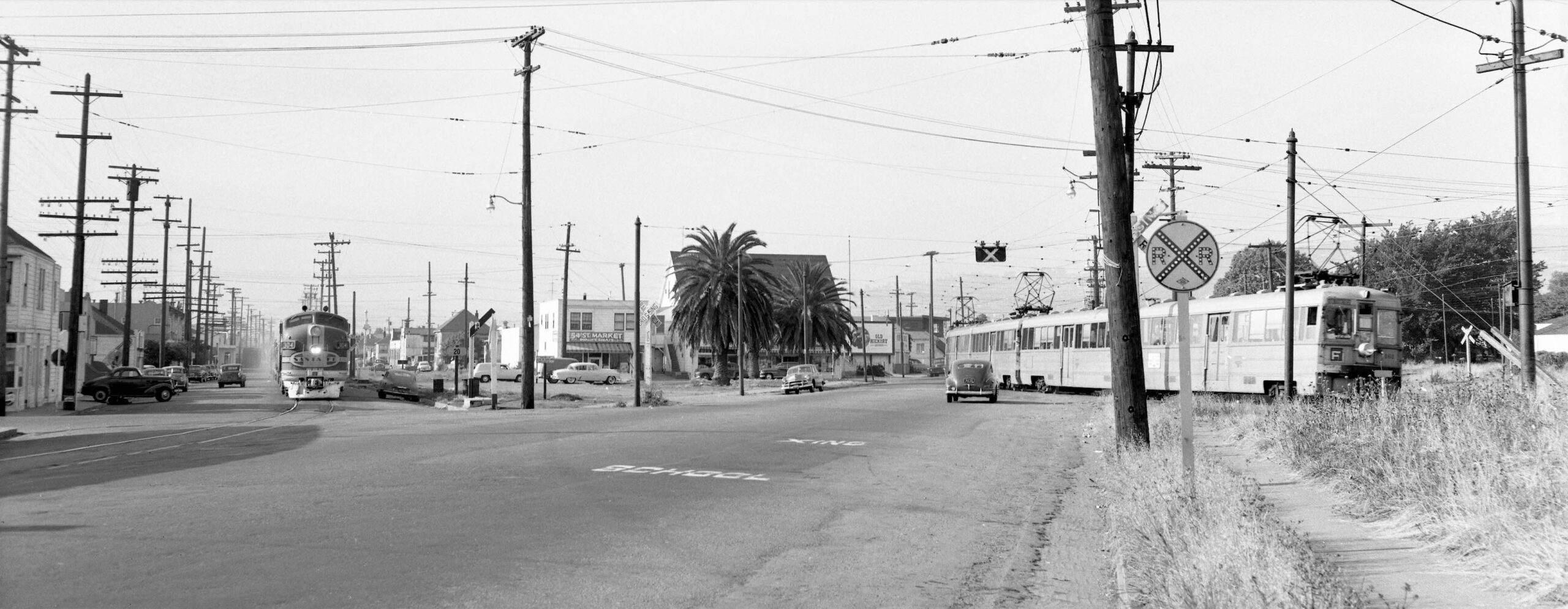
The proximity of Santa Fe and Key System routes helped concentrate industry along the corridor, serving businesses such as the Aluminum Cooking Utensil Company and Remar Bakery, which relied on both freight access and commuter labor.
Interurban rail peaked early. While World War II briefly revived ridership, the long-term trend was clear. Rising automobile ownership, postwar freeway construction, and changing land-use priorities led to the Key System’s closure in 1958. Its tracks were quickly dismantled.
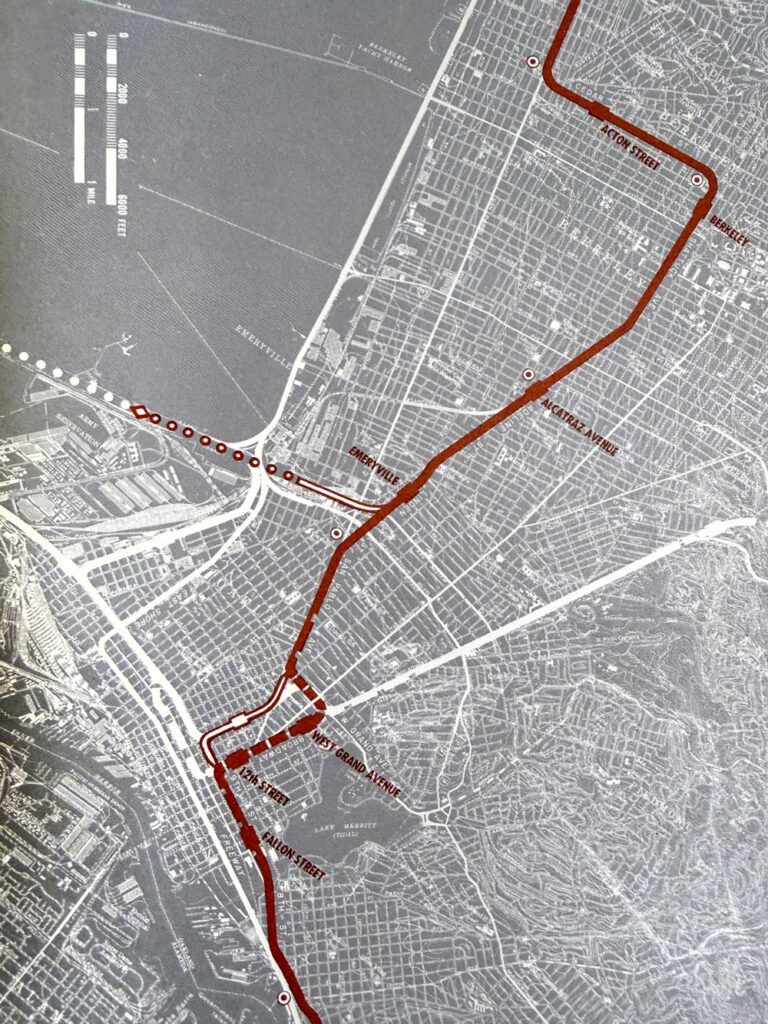
The Linden St. corridor was briefly considered for what would have been a segment of today’s “orange” line from Fremont to Richmond when BART was being studied and planned in the 1950s. This would have included an “Emeryville” Station on Linden Street between 43rd and 44th streets roughly where the Key System Line E had a station.
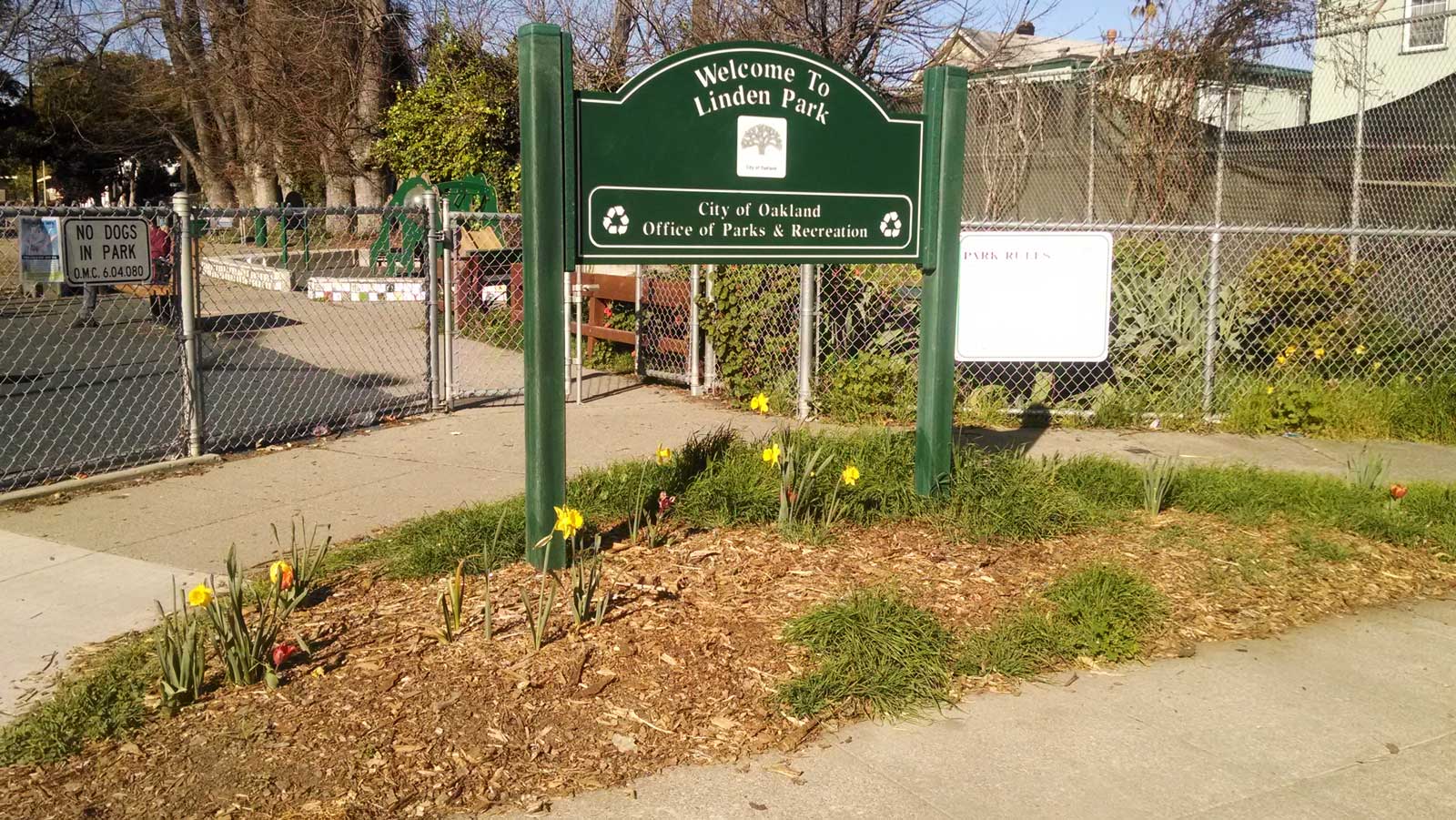
Most of the Linden Street alignment was quietly absorbed into streets, utilities, and redevelopment parcels. An exception is Linden Park, which preserves a fragment of the former right-of-way. Its narrow, linear form reflects the geometry of the rail corridor and offers one of the few visible reminders that electric trains once passed through this neighborhood.
Together, the Adeline and Linden corridors tell a layered story of competition, connectivity, decline, and reuse—one that continues to shape the landscape long after the trains are gone.
For those looking to learn more about the importance and impact of rail transit, we highly recommend browsing the East Bay Hills Project website or taking a day trip to the Western Railway Museum.
