



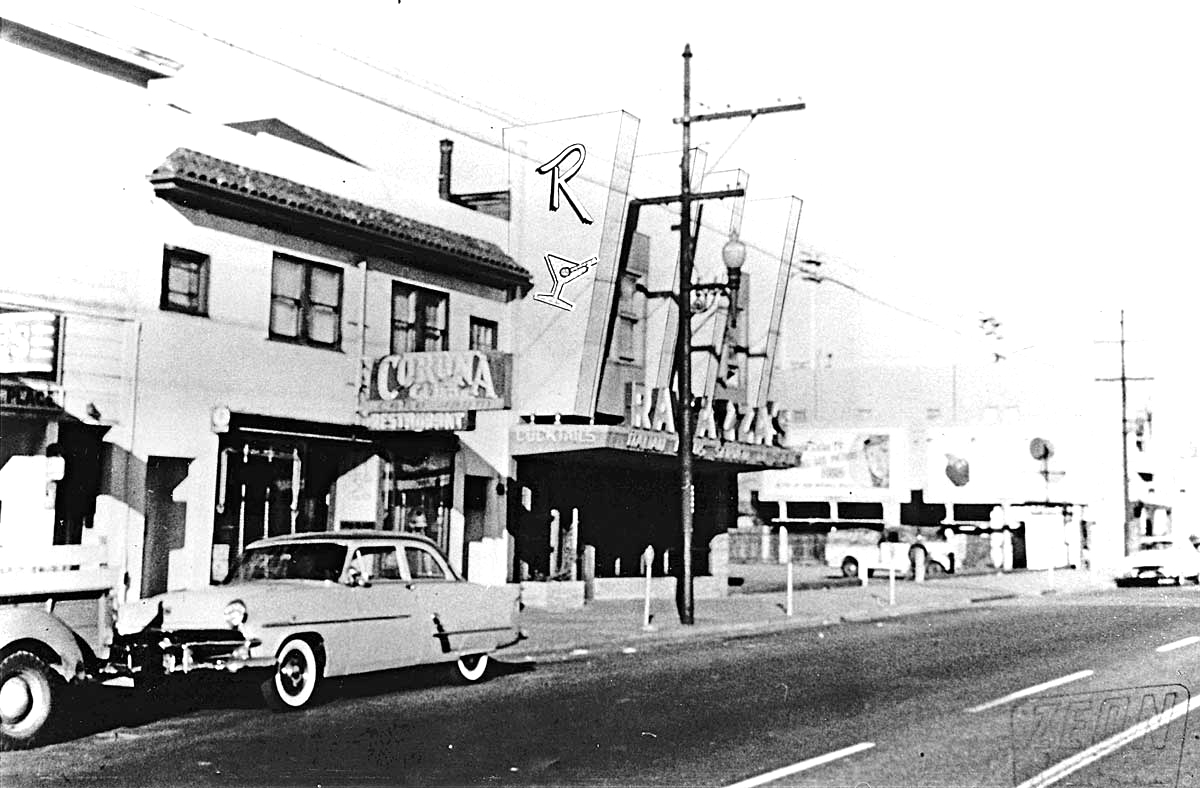
Ravazza’s & The Corona Club
When the Oakland Oaks built their ballpark along nearby Park Avenue in 1913, this stretch of San Pablo Avenue transformed almost overnight. What had been a fairly ordinary commercial strip became a lively pre- and post-game promenade. On summer afternoons and warm evening nights, fans poured out of the wooden grandstands and into the surrounding bars, cafés, and card rooms.
After World War II, the energy intensified. Emeryville’s industrial boom meant factories operated around the clock, with workers heading off shift just as ballgames let out. The rhythm of baseball and industry overlapped, and San Pablo Avenue pulsed with activity nearly 24 hours a day.
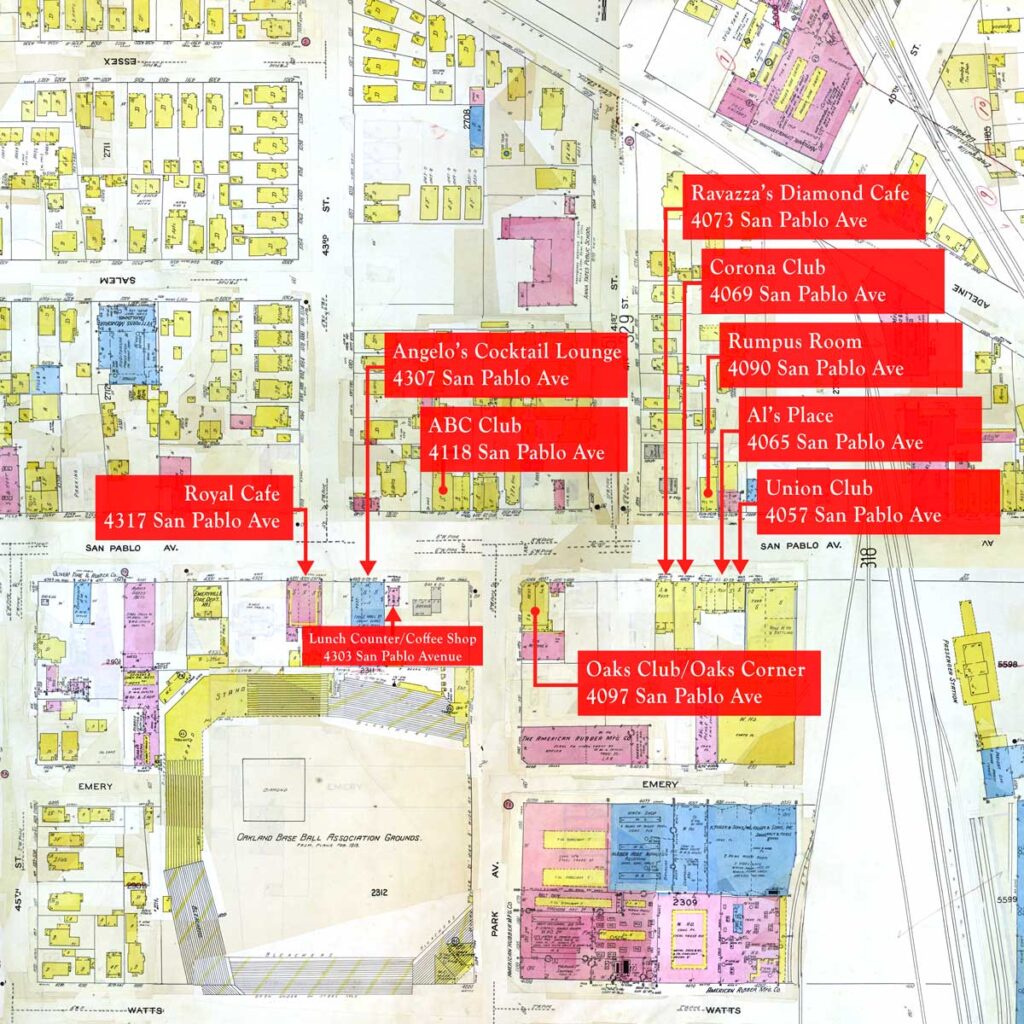
By the late 1940s, Park Avenue and San Pablo were the epicenter of what some newspaper accounts grandly called “Metropolitan Oakland.” The names that defined this corner—Angelo’s, Ravazza’s Diamond Café, and the Corona Club—became part of local lore.
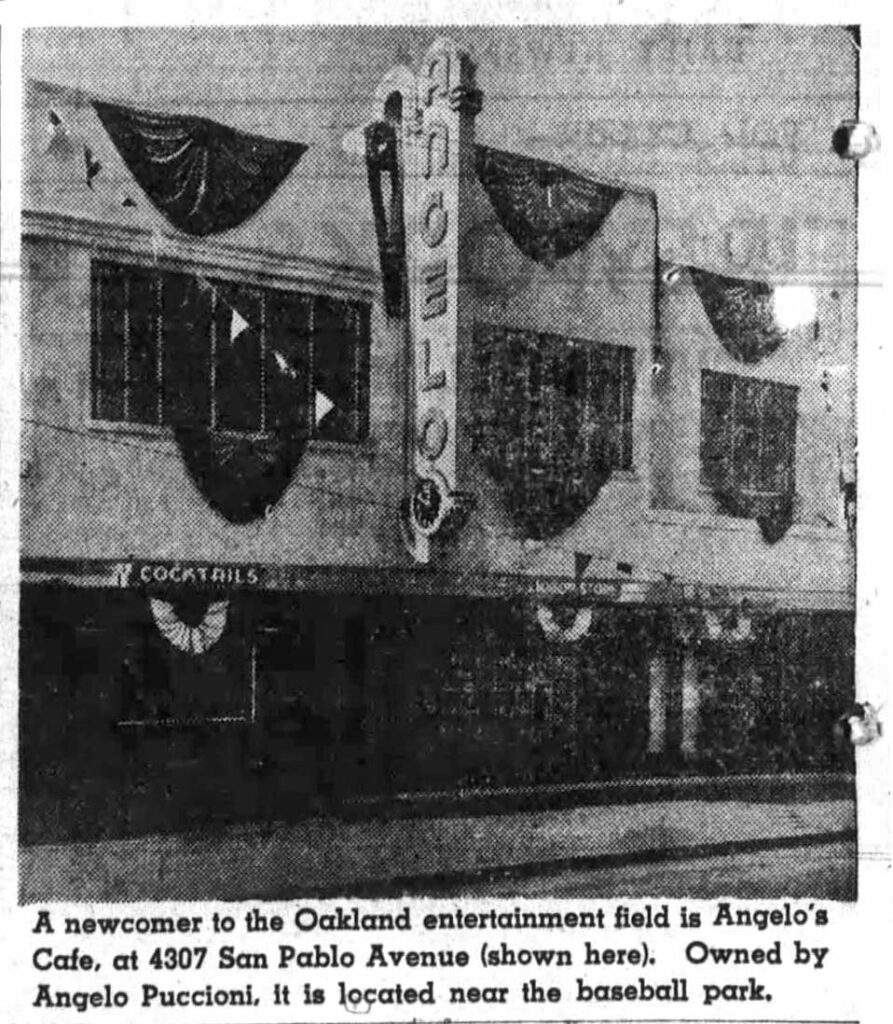
Angelo’s – 4307 San Pablo Avenue
Angelo Puccioni opened Angelo’s Restaurant in January 1941, after many years operating the Royal Café on the same block. The two-story building featured a modern cocktail lounge and restaurant on the ground floor, complete with an open fireplace—a warm gathering place for ballplayers, longshoremen, and local families alike.
Puccioni’s death in 1964 marked the beginning of the end for Angelo’s. The restaurant soon closed, and the building later hosted a variety of uses, often functioning as an event space. For decades, though, it stood as a reminder of San Pablo Avenue’s baseball heyday.
Ravazza’s Diamond Café – 4073 San Pablo Avenue
The longest-running of the Oaks-era establishments was Ravazza’s Diamond Café. On June 4, 1946, North Oakland native Jack Ravazza realized his dream of opening a restaurant that showcased his mother Elena’s Italian recipes.
Jack and his wife Betty became fixtures at the front door, welcoming a clientele that ranged from factory workers and local politicians to sports stars and Hollywood celebrities. Inside was a full bar and stylish dining room; outside, a distinctive Moderne façade with four parallel projections crowned the entrance.
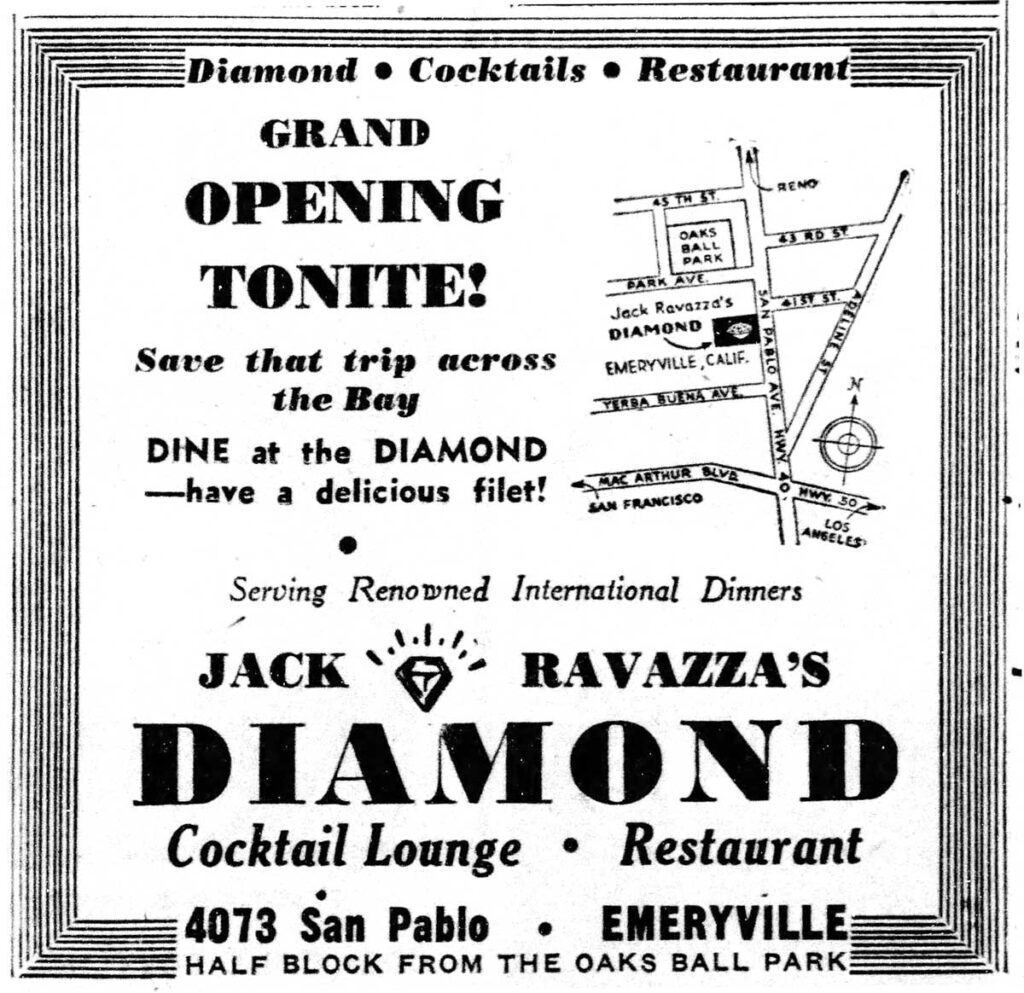
The walls were lined with autographed photographs—Harry James, Betty Grable, Jimmy Durante, Casey Stengel, Billy Martin, Bill Rigney, Wilt Chamberlain, Bill Russell—evidence of the restaurant’s deep ties to the sporting and entertainment worlds.
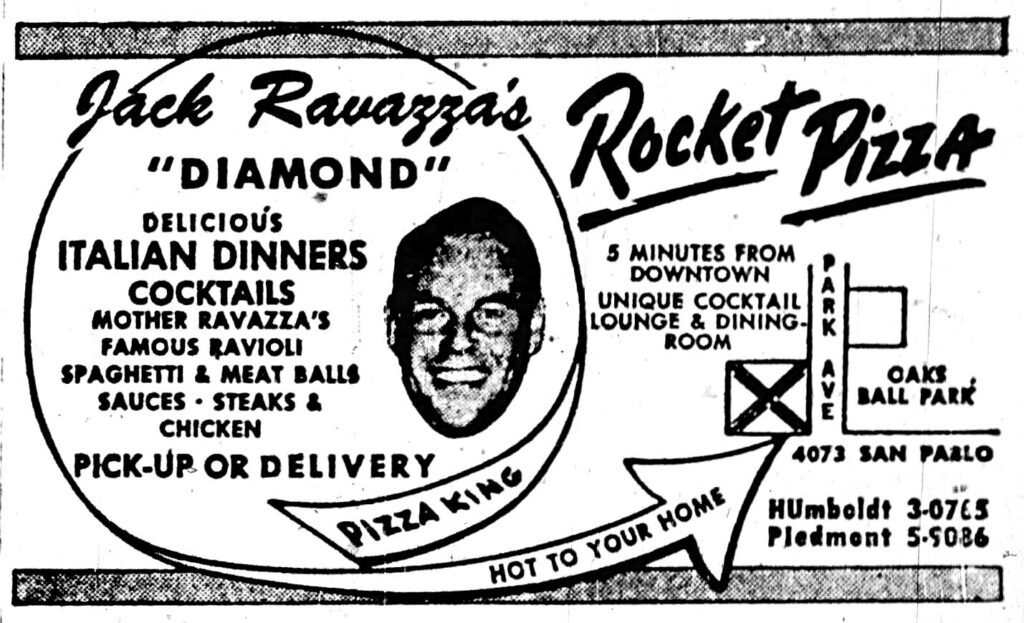
Around 1951, Ravazza’s added pizza to the menu and launched a home delivery service dubbed “Ravazza’s Rocket Pizza,” an early nod to Emeryville’s evolving, car-centered culture.
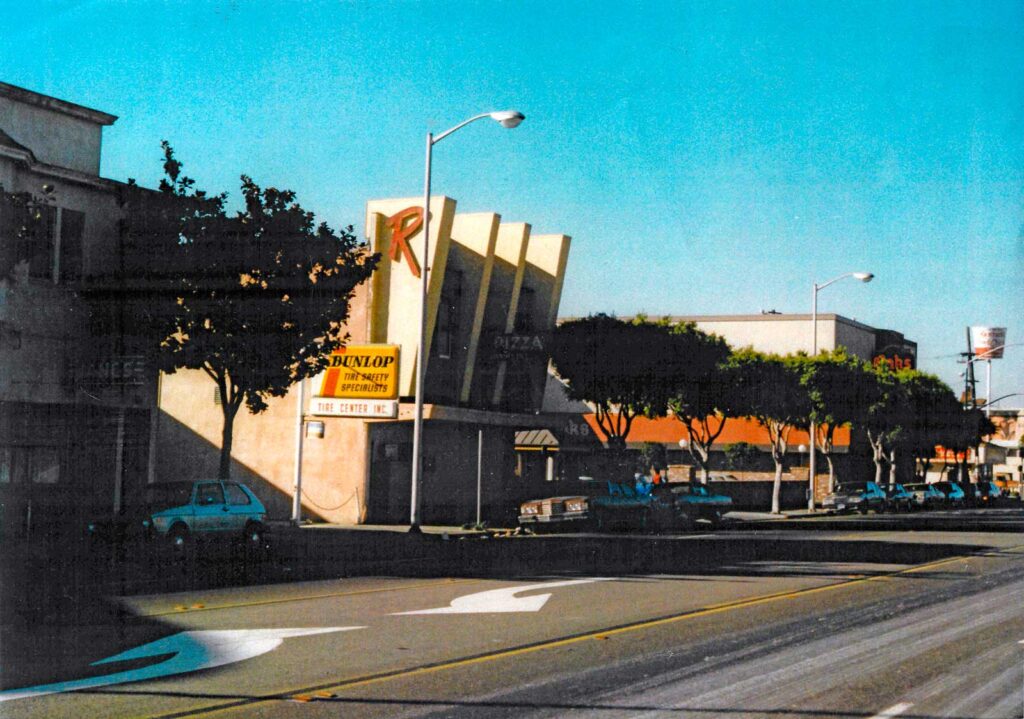
After nearly forty years in business, Ravazza’s closed in 1985. Jack Ravazza passed away in 2002 at the age of 89, but his restaurant remains one of the most fondly remembered landmarks of the era.
The Corona Club – 4069 San Pablo Avenue
Next door, the Corona Club opened in 1946 in the former Oaks Cocktail Lounge space. Proprietor Sam Olson, formerly of the Rex Club at 3600 San Pablo, operated it as both bar and café, though it was best known as a cardroom.
Its clientele included truck drivers, servicemen, and businessmen, alongside a more shadowy cast of hustlers and loan sharks who worked the tables. After Olson’s death in 1964, his son Albert continued operations until 1969, later opening the Vegas Club across the street.
Rise and Fall of a Baseball Economy
The Oaks reached their pinnacle in 1948, winning the Pacific Coast League championship and leading the league in attendance. That season marked the high tide—not just for the team, but for the businesses that depended on game-day crowds.
In the years that followed, television flickered into living rooms, families moved to the suburbs, and the wooden grandstand at Oaks Park began to feel like a relic of another era. Attendance declined gradually. When the Oaks relocated to Vancouver in 1955, Emeryville lost not just a ballclub, but a powerful social and economic anchor.
Some establishments with loyal followings survived the transition. Others faded as the crowds thinned.
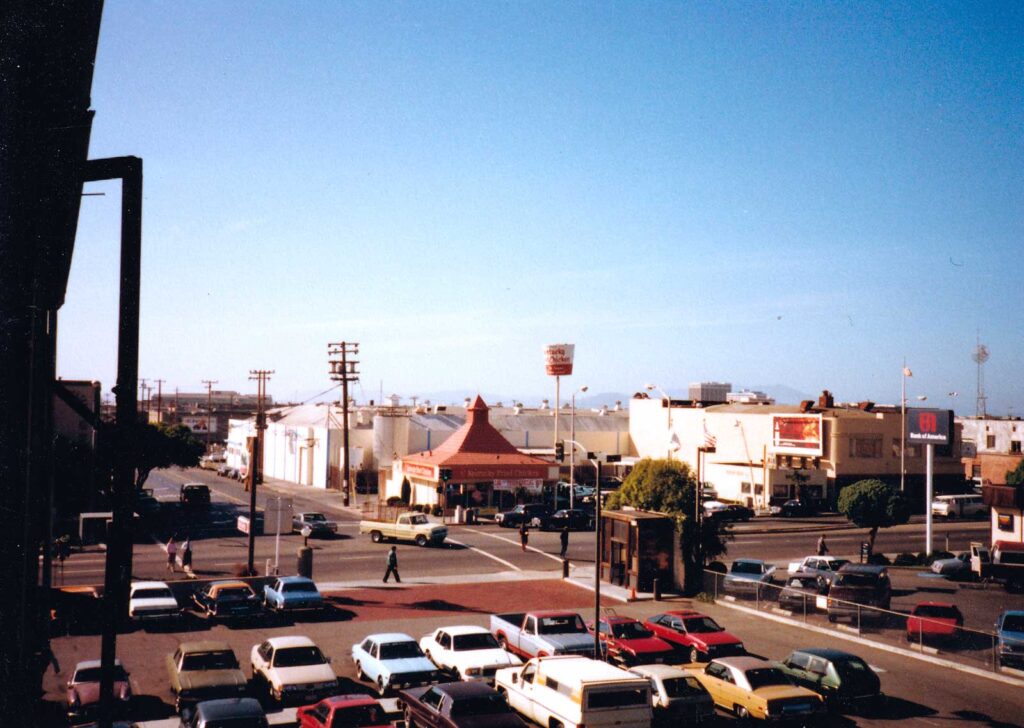
Ravazza’s closure in 1985 left the Oaks Corner and its attached card club as the last living link to that golden age—an institution that endured by adapting to a century of change. The original Corona Club and Ravazza’s buildings were eventually demolished after being acquired by the Oaks Club, and today the site forms part of its customer parking lot.
Thank you for taking our San Pablo Ave/Triangle tour. Ready for another? Take our Park Avenue District or Emeryville Greenway tour.
